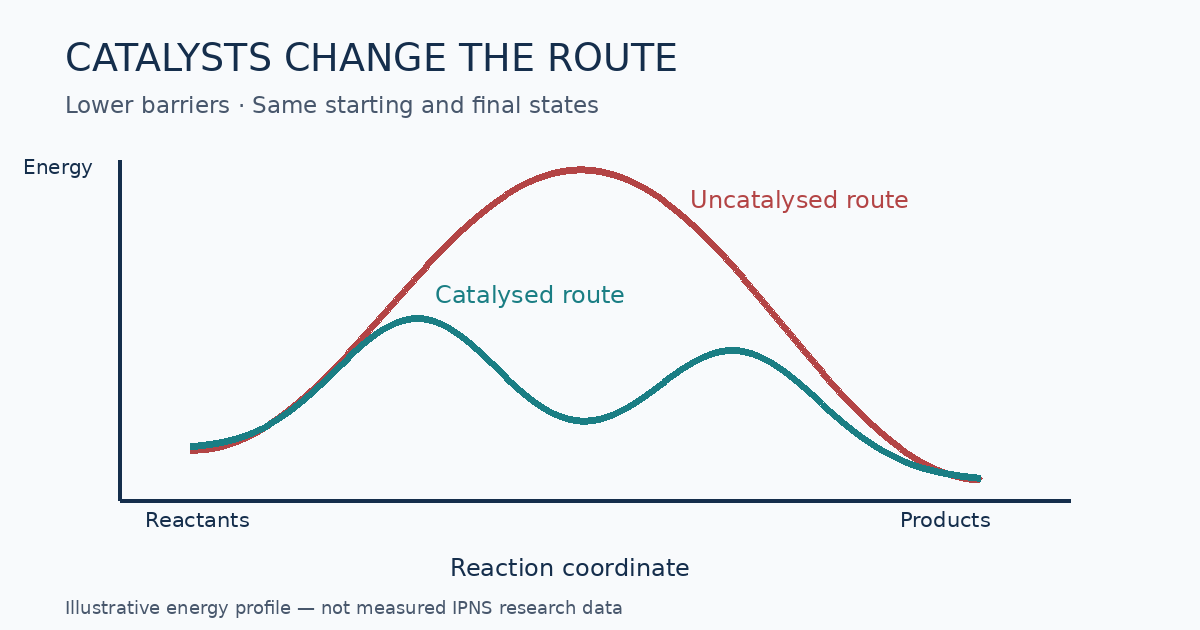
Quick answer: A catalyst does not make a reaction “more favourable”; it provides a different pathway that can lower the kinetic barriers between reactants and products. A 9 October 2026 Nature Catalysis study on penicillin biosynthesis gives students a useful real-world example of activation energy, reaction intermediates and how scientists test a proposed mechanism.
One reason I value research-linked Chemistry examples is that they force us to go beyond memorised definitions. Students may know that “enzymes are biological catalysts,” but the deeper question is: what actually changes along the reaction pathway?
What the new penicillin research shows
Researchers studying isopenicillin N synthase used time-resolved structural methods together with spectroscopy, biochemical experiments and calculations to investigate short-lived stages in the enzyme-catalysed reaction that forms the penicillin ring system. They identified intermediates that help explain how the enzyme carries out a difficult sequence of bond-making steps.
The phrase “molecular movie” is useful, but it should not be misunderstood. Scientists did not film one molecule continuously with an ordinary camera. They reconstructed the reaction sequence from structural measurements collected at different times.
The Chemistry lesson for students
The first lesson is about activation energy. A reaction can be thermodynamically possible and still proceed very slowly because the pathway contains large energy barriers. A catalyst changes the route, not the overall thermodynamic destination.
The second lesson is about intermediates. In a multistep reaction, an intermediate is formed in one step and consumed in another. It is not the same as a transition state. This distinction is especially important for JEE students reading reaction-coordinate diagrams.
The third lesson is about evidence. Drawing a plausible mechanism is not enough. Researchers need observations that distinguish one proposed pathway from another. This is a habit students should carry into Chemistry problem solving: do not jump from a familiar rule to a conclusion without checking whether the evidence actually supports it.
What students should not conclude
This study does not mean that a new antibiotic has been approved, that antibiotic resistance has been solved, or that industrial penicillin production has suddenly changed. It is mechanistic research. Its immediate educational value is that it helps us see catalysis and reaction pathways more clearly.
Why this matters in the classroom
For CBSE and NEET students, the research is a real-world way to strengthen enzyme catalysis and activation-energy concepts. For JEE students, it adds another layer: distinguishing intermediates from transition states and understanding why a catalyst affects kinetics without changing the equilibrium constant for a specified reaction at fixed temperature.
This is similar to the way I use equilibrium-and-kinetics research to deepen textbook ideas. See also my earlier note, Can Changing Temperature Improve Ammonia Synthesis?
I have explained the Chemistry, research limitations, CBSE/JEE/NEET relevance and five solved concept questions in detail on Topper Formula:
Enzyme Catalysis and Activation Energy: What a Penicillin Molecular Movie Teaches Us
Original research: Rabe, P. and colleagues, Nature Catalysis, published 9 October 2026. DOI: 10.1038/s41929-026-01618-4.
Lalit Kumar Mishra
Chemistry Educator • Student Success Mentor • Author