Author: Lalit Kumar Mishra

  • What an RO Water Purifier Teaches Students About Pressure and Molecular Selectivity

    What does an RO water purifier teach us about Chemistry? It reveals two different principles: pressure drives reverse osmosis, while the membrane’s molecular structure helps determine which substances pass through. Students learn more when they keep the driving force separate from membrane selectivity.

    As a Chemistry educator, I see this as a useful way to connect Class 12 Solutions with Class 11 hydrogen bonding. A 2026 membrane study gives us an example of why the material’s chemistry matters—but it does not mean the new membrane is already present in ordinary household purifiers.

    Two different questions, not one

    The first question is about driving force. Ordinary osmosis moves solvent toward the solution side of a semipermeable membrane. In the ideal textbook model, external pressure on the solution side can stop that net movement and, when it exceeds the osmotic-pressure difference, reverse it.

    The second question is about selectivity. Molecules must encounter and move through an actual material. How they interact with that material matters. A membrane is not merely an imaginary line that distinguishes water from salt.

    A recent research example

    A Nature Communications study reported on 16 October 2026 examined an RO membrane containing artificial channels with hydroxyl (–OH) groups. The researchers described improved water transport alongside strong rejection of salt and NDMA, a small organic contaminant, and explored how dynamic hydrogen bonding could contribute to selective transport.

    This makes a beautiful bridge between two chapters: Class 11 Chemical Bonding, where students meet hydrogen bonding, and Class 12 Solutions, where they learn osmotic pressure and reverse osmosis.

    Hydrogen bonds in a water channel are not permanent handcuffs. They continually form and break. That dynamic behaviour is precisely why chemistry can be more informative than the simplistic picture of a membrane as a rigid sieve.

    What did the study show—and what did it not establish?

    Reported finding: In laboratory tests, the research team observed improved water transport alongside strong rejection of certain tested substances, including salt and NDMA, using artificial hydroxyl-containing water channels in a polyamide membrane.

    Not established by this result alone: universal contaminant removal, use in every household RO system, or long-term commercial durability. Those are separate questions requiring further evidence.

    The question I would ask in class

    “If a membrane allows water to pass more quickly, must it automatically reject every contaminant more efficiently?”

    No. Water transport and contaminant rejection are distinct measurements. A laboratory improvement in one design is also not proof that the same membrane has already passed the durability and operating tests required for widespread commercial use.

    I want students to develop the habit of asking what a result actually demonstrates and what remains to be tested. That is as much a part of learning Chemistry as memorising a formula.

    Questions worth asking after learning reverse osmosis

    Is the pressure needed for reverse osmosis the same as membrane selectivity?

    No. The applied pressure difference drives solvent movement; selectivity describes how readily the membrane lets different substances through. A material can transport water rapidly without rejecting every solute equally well.

    Does successful laboratory research mean an RO membrane is ready for household use?

    No. Laboratory findings are a starting point. Reliability, fouling, durability, contaminant-specific rejection and performance in realistic water still need to be established.

    For the detailed CBSE Class 12 explanation, including an osmotic-pressure example and common misconceptions, see the full lesson on Topper Formula.

    Research source: Qiu and colleagues, “Hydroxy artificial water channels enable ultraselective reverse osmosis membranes for N-nitrosamine removal in water reuse”, Nature Communications (reported 16 October 2026). DOI: 10.1038/s41467-026-78721-4. The interpretation above distinguishes the study’s reported laboratory findings from established textbook principles and commercial-product claims.

  • What Plastic Adhesion Can Teach Students About Carbonyl Groups

    Quick answer: The new polyethylene research is a useful reminder that Chemistry is often about where a change happens, not only what functional group is present. By introducing selected carbonyl groups at the surface, researchers changed how polyethylene interacted with polar materials without showing that the whole polymer had become a different substance.

    Students often learn functional groups as isolated facts: ketones contain a carbonyl group, oxygen is more electronegative than carbon, and polar bonds can influence intermolecular forces. This research turns those facts into a real materials question: why can a plastic be difficult to glue, and what happens if we change only its surface?

    What the research helps students see

    Polyethylene is built mainly from C–C and C–H bonds. Its surface is therefore relatively non-polar. Many adhesives or contacting materials are more polar, so the interface may not support strong enough interactions for good adhesion.

    In the 13 October 2026 Nature study, researchers selectively oxidised the polyethylene surface and introduced ketone groups. The C=O bond is polar, and the oxygen atom can act as a hydrogen-bond acceptor. That gives the surface new ways to interact with suitable neighbouring groups.

    The important teaching point is not simply “carbonyl groups improve glue.” It is the broader idea of surface engineering: modify the outside for a particular function while trying to preserve useful properties of the material underneath.

    A useful distinction for Chemistry students

    Students should separate three claims:

    • the surface became more polar,
    • adhesion to tested polar materials improved,
    • the whole polymer became biodegradable or water-soluble.

    The first two are connected to what the researchers measured. The third does not follow automatically. A surface modification is not the same as changing the bulk polymer.

    This is the same reasoning habit I want students to use in exams: one correct fact does not justify every conclusion that sounds related.

    Why I would use this in class

    For Class 11, it connects naturally with bond polarity and intermolecular interactions. For Class 12, it reinforces the carbonyl group in ketones. For JEE and NEET students, it is a good structure–property example. Students do not need to memorise the research reaction itself.

    I have explained the full Chemistry, limitations, CBSE/JEE/NEET relevance and practice questions in detail on Topper Formula:

    Why Is Polyethylene Difficult to Glue? Carbonyl Groups Explain the Chemistry

    Original research: Cristian P. Woroch and colleagues, Nature, 13 October 2026. DOI: 10.1038/s41586-026-11255-3.

    If you prefer structured learning beyond individual articles, you can also explore my books and learning resources.


    Lalit Kumar Mishra
    Chemistry Educator • Student Success Mentor • Author

  • What a Penicillin Molecular Movie Can Teach Students About Catalysis

    What a Penicillin Molecular Movie Can Teach Students About Catalysis

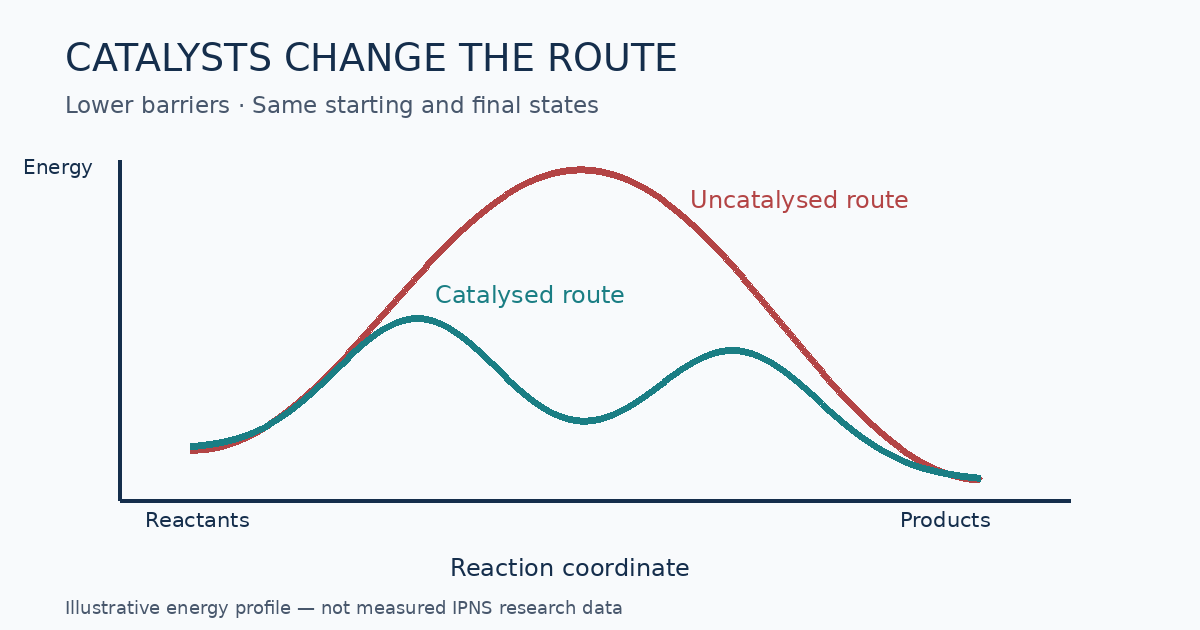
    Quick answer: A catalyst does not make a reaction “more favourable”; it provides a different pathway that can lower the kinetic barriers between reactants and products. A 9 October 2026 Nature Catalysis study on penicillin biosynthesis gives students a useful real-world example of activation energy, reaction intermediates and how scientists test a proposed mechanism.

    One reason I value research-linked Chemistry examples is that they force us to go beyond memorised definitions. Students may know that “enzymes are biological catalysts,” but the deeper question is: what actually changes along the reaction pathway?

    What the new penicillin research shows

    Researchers studying isopenicillin N synthase used time-resolved structural methods together with spectroscopy, biochemical experiments and calculations to investigate short-lived stages in the enzyme-catalysed reaction that forms the penicillin ring system. They identified intermediates that help explain how the enzyme carries out a difficult sequence of bond-making steps.

    The phrase “molecular movie” is useful, but it should not be misunderstood. Scientists did not film one molecule continuously with an ordinary camera. They reconstructed the reaction sequence from structural measurements collected at different times.

    The Chemistry lesson for students

    The first lesson is about activation energy. A reaction can be thermodynamically possible and still proceed very slowly because the pathway contains large energy barriers. A catalyst changes the route, not the overall thermodynamic destination.

    The second lesson is about intermediates. In a multistep reaction, an intermediate is formed in one step and consumed in another. It is not the same as a transition state. This distinction is especially important for JEE students reading reaction-coordinate diagrams.

    The third lesson is about evidence. Drawing a plausible mechanism is not enough. Researchers need observations that distinguish one proposed pathway from another. This is a habit students should carry into Chemistry problem solving: do not jump from a familiar rule to a conclusion without checking whether the evidence actually supports it.

    What students should not conclude

    This study does not mean that a new antibiotic has been approved, that antibiotic resistance has been solved, or that industrial penicillin production has suddenly changed. It is mechanistic research. Its immediate educational value is that it helps us see catalysis and reaction pathways more clearly.

    Why this matters in the classroom

    For CBSE and NEET students, the research is a real-world way to strengthen enzyme catalysis and activation-energy concepts. For JEE students, it adds another layer: distinguishing intermediates from transition states and understanding why a catalyst affects kinetics without changing the equilibrium constant for a specified reaction at fixed temperature.

    This is similar to the way I use equilibrium-and-kinetics research to deepen textbook ideas. See also my earlier note, Can Changing Temperature Improve Ammonia Synthesis?

    I have explained the Chemistry, research limitations, CBSE/JEE/NEET relevance and five solved concept questions in detail on Topper Formula:

    Enzyme Catalysis and Activation Energy: What a Penicillin Molecular Movie Teaches Us

    Original research: Rabe, P. and colleagues, Nature Catalysis, published 9 October 2026. DOI: 10.1038/s41929-026-01618-4.


    Lalit Kumar Mishra
    Chemistry Educator • Student Success Mentor • Author

  • What Bee Repellents Can Teach Students About Vapour Pressure

    Research note for students and teachers

    A good Chemistry lesson should not end with a definition. It should help a student see where the idea appears in the real world.

    A recent honey-bee study offers a useful example. Researchers used molecular information and behavioural data to identify chemical structures that might act as bee repellents. The interesting classroom question is not simply whether a chemical “repels bees,” but how a molecule reaches the bee through the air in the first place.

    Where vapour pressure enters the story

    For an odour to reach an insect, at least some molecules must leave their source and enter the gas phase. That immediately brings us to familiar Chemistry ideas: intermolecular forces, volatility and vapour pressure.

    In general, stronger intermolecular attractions make it harder for molecules to escape from the liquid phase, so comparable substances often show lower vapour pressure. Hydrogen bonding, dipole–dipole attraction, molecular size, shape and polarizability can all matter.

    But this is also where students need to avoid oversimplification. A substance being volatile does not automatically mean that it will be an effective repellent. A molecule must also interact appropriately with biological receptors, and field conditions such as temperature, wind and formulation matter.

    The lesson is bigger than vapour pressure

    What I like about examples like this is that they force students to separate three different questions:

    • Can the molecule enter the air?
    • Can it interact with the relevant receptor?
    • Does the full system work under real experimental conditions?

    This is the same habit I want students to develop in exam problem solving: do not jump from one correct fact to an unjustified conclusion.

    A student who has memorised “stronger intermolecular force means lower vapour pressure” still has to ask whether the comparison controls molecular size, shape and other structural factors. Good Chemistry is not just recalling a rule; it is knowing when the rule is safe to use.

    What students should take from the research

    For CBSE, JEE and NEET preparation, students do not need to memorise this research paper. Its value is as a real-world application of concepts they already study.

    The practical takeaway is simple: when comparing physical properties, identify the dominant intermolecular forces first, then check molecular size, shape and polarizability before deciding.

    I have explained the Chemistry in more detail—with examples, exam relevance and practice questions—on Topper Formula:

    Intermolecular Forces and Vapour Pressure: Can Bees Avoid a Chemical?

    The original research is available from eLife.


    Lalit Kumar Mishra
    Chemistry Educator • Student Success Mentor • Author

  • How Students Can Build Exam Confidence Through Preparation—Not Empty Motivation

    How Students Can Build Exam Confidence Through Preparation—Not Empty Motivation

    Genuine exam confidence does not come from repeatedly telling a student to “be positive.” It grows from evidence: concepts understood, information recalled without help, questions solved independently, mistakes corrected and tests completed under realistic conditions. Confidence becomes dependable when preparation produces proof that the student can perform.

    A student may appear confident while studying at home and still feel uncertain in an examination hall. Another student may know the syllabus but become disturbed by one difficult question. These reactions do not automatically mean that the learner lacks ability. Often, the preparation has not yet been converted into enough independent, timed and reviewed performance.

    The practical question is therefore not simply, “How can I feel confident?” It is: “What evidence can I create before the examination that shows I am ready to recall, apply, write and recover under pressure?”

    Why motivation alone does not create lasting confidence

    Encouragement matters, especially after disappointment. But confidence based only on reassurance is fragile. A student may feel encouraged at night and become uncertain again when an unfamiliar question appears the next morning. Lasting confidence needs a preparation system that survives changes in mood.

    Reading notes repeatedly can also create a misleading sense of readiness. The page looks familiar, so the student feels that the topic is known. Yet an examination does not ask whether the page looks familiar. It asks the learner to retrieve information, select a method, apply it correctly and present the answer within a time limit.

    Confidence is not the same as overconfidence

    Genuine confidence is specific and testable: “I can solve this type of numerical without looking at the formula,” or “I can explain this reaction mechanism and predict the product when the substrate changes.” Overconfidence is vague: “I have read everything, so I will manage somehow.”

    A confident student still checks units, conditions, signs, structures and instructions. Confidence improves attention; it does not remove the need for verification. The best preparation combines belief in one’s ability with respect for the demands of the paper.

    The five foundations of exam confidence

    1. Concept clarity

    The student should be able to explain the main idea in their own words, connect it with earlier knowledge and recognise when it applies. Memorising a formula or reaction without understanding its conditions produces confidence only for identical questions.

    Self-check: Can I explain why the method works, not merely repeat the steps?

    Practical correction: Choose one unclear concept, study it from a reliable source, explain it aloud and then solve two different applications.

    2. Active recall

    Close the book and retrieve the idea. Write the definition, formula, mechanism, sequence or explanation from memory before checking. This exposes the difference between recognising information and being able to produce it independently.

    Self-check: Can I reproduce the essential points without seeing the page?

    Practical correction: Use short closed-book recall rounds, check immediately and repeat the missing part later. Research on retrieval practice has found that repeated retrieval can strengthen later retention more effectively than repeated study alone. See this Science study on retrieval for learning.

    You may also use the step-by-step method in Active Recall for Students: How to Remember What You Study.

    3. Independent written and problem practice

    Watching a teacher solve a problem and producing a solution independently are different skills. Students need to choose the governing principle, represent the information, carry out the steps and check the result without depending on prompts.

    Self-check: Can I solve a changed version of the question on a blank page?

    Practical correction: After every studied example, attempt one similar question and one modified question without looking at the solution. Students facing this gap in Chemistry can use the diagnostic process in Why Students Understand Chemistry but Cannot Solve Questions.

    4. Timed test experience

    A student may know the content but still lose marks through slow recall, poor question selection or weak time allocation. Timed practice teaches the learner when to continue, when to move on and how much detail a particular mark value requires.

    Self-check: Can I complete a realistic set accurately within the available time?

    Practical correction: Begin with a short timed section. Review both accuracy and decision-making before attempting another test.

    5. Mistake correction and retesting

    A checked paper is not necessarily a corrected paper. If the student reads the solution, understands it and moves on, the same error may return. Confidence grows when an error is classified, corrected and then tested again after a gap.

    Self-check: Can I now solve the question that I previously answered incorrectly?

    Practical correction: Classify the error as concept, recall, execution, time or strategy; repair the cause; then retry the question independently. The article Why Students Repeat the Same Mistakes Even After Studying Hard explains this process in more detail.

    The preparation–confidence cycle

    Stage Student action Evidence created
    Prepare Understand the concept and organise the essentials. Clear explanation and usable notes
    Practise Recall, write and solve without prompts. Independent production
    Test Work under a realistic limit. Performance under conditions
    Analyse Classify where marks were lost. Specific diagnosis
    Correct Repair the cause, not only the answer. Improved method
    Retest Attempt the weak area again after a gap. Proof of improvement
    Build confidence Use the accumulated evidence honestly. Calm, realistic readiness

    How this looks in Chemistry

    Physical Chemistry

    Confidence is not established by remembering a formula. The student should identify the correct relationship, convert units, substitute carefully, interpret the sign and judge whether the result is chemically reasonable. Solve unfamiliar numerical variations, not only repeated examples.

    Organic Chemistry

    A reaction list can feel secure until the substrate or condition changes. Build confidence by identifying the functional group, reagent, reaction type and electron movement. Practise predicting products and explaining why a competing product is less likely.

    Inorganic Chemistry

    Recall is necessary, but isolated facts are difficult to retain. Connect trends with electronic configuration, oxidation state, size, charge and bonding. Then practise the important exceptions separately and explain the reason wherever the syllabus permits.

    A seven-day confidence-building plan

    1. Day 1 — Diagnose: Attempt a short mixed test and identify the largest gap: concept, recall, practice, time or strategy.
    2. Day 2 — Repair: Study the weakest prerequisite or concept and explain it without copying the source.
    3. Day 3 — Retrieve: Use closed-book recall for formulas, definitions, reactions, steps or key explanations.
    4. Day 4 — Practise: Complete a focused set of written answers or problems independently.
    5. Day 5 — Analyse: Classify mistakes, correct the cause and record only the errors worth revisiting.
    6. Day 6 — Retest: Retry representative wrong questions without looking at the previous solution.
    7. Day 7 — Simulate and review: Take a short timed test, compare the evidence with Day 1 and set the next priority.

    A regular weekly study review can turn this seven-day cycle into a sustainable habit.

    What to do in the final 24 hours

    • Review a short, already-prepared list of formulas, reactions, definitions, exceptions and frequent errors.
    • Avoid opening large new topics that cannot be understood and practised properly.
    • Complete only a small confidence set; do not exhaust yourself with an unnecessarily long paper.
    • Prepare practical details such as reporting time, stationery and required documents.
    • Protect sleep and follow a calm routine. Last-minute panic is not evidence of serious preparation.
    • Enter the examination with a simple strategy: scan, select, allocate time, attempt and check.

    How to respond after one poor test

    One test is evidence, not an identity. Do not convert a disappointing score into “I am weak” or “I cannot do this subject.” Separate the result into causes. Was the content unclear? Was recall slow? Were questions misread? Did the student run out of time? Did one early mistake damage concentration?

    Choose the largest repeated cause and make one correction measurable. “Be careful” is not a plan. “Circle command words, reserve ten minutes for checking and retry three calculation questions on Friday” is a plan.

    When a student is unable to recover after repeated poor results, structured support may help. Read How Mentoring Can Help After Poor Examination Results.

    What parents should say—and avoid saying

    Parents can protect confidence without ignoring responsibility. Begin with evidence and curiosity: “Where did the paper become difficult?” or “Which type of error cost the most marks?” Recognise genuine preparation, then help the student improve the system.

    Useful responses include:

    • “Let us identify the part of preparation that did not transfer into the test.”
    • “Choose one correction for this week and review the evidence next weekend.”
    • “A poor score matters, but it does not define your ability or your future.”

    Avoid:

    • comparisons with siblings, classmates or rank holders;
    • labels such as lazy, careless, weak or overconfident;
    • demanding more study hours before identifying what those hours should contain;
    • offering empty guarantees that the next examination will certainly go well.

    Parents may also use How Parents Should Respond to Low Marks Without Blame for a constructive post-result conversation.

    How this connects with Topper Formula and The Clarity Blueprint Method™

    The Topper Formula Learning System™ treats confidence as the result of a sequence: Clarity → Concept → Practice → Assessment → Analysis → Improvement → Confidence → Performance → Success. The Clarity Blueprint Method™ adds purposeful direction, responsible action and reflection. Together, these approaches replace vague motivation with a cycle students can observe and improve.

    A student does not need to feel completely fearless before acting. The next meaningful step may be small: recalling one topic, solving five questions, correcting one recurring error or completing one timed section. Repeated evidence from these actions gradually makes confidence more stable.

    When nervousness may require additional support

    Some nervousness before an examination is common. Educational strategies can help when the main problem involves preparation, recall, practice, planning or test behaviour. However, persistent or severe distress, panic symptoms, major sleep disruption, inability to cope or continuing interference with daily life deserves attention from an appropriately qualified health or mental-health professional. Educational mentoring does not diagnose or treat anxiety disorders.

    For general guidance on student stress and when to seek help, see the NHS student-stress guidance.

    Frequently asked questions

    How can students build confidence before an examination?

    Students build confidence by creating evidence of readiness. They should understand concepts, retrieve information without notes, solve questions independently, complete timed practice, analyse mistakes and retest weak areas. Confidence becomes more dependable when it is based on completed actions rather than reassurance or motivation alone.

    Why do prepared students sometimes lose confidence during a test?

    Preparation may not have included unfamiliar questions, timed recall, question selection or recovery after a difficult item. A student can know the content yet become unsettled by examination conditions. Short simulations and a clear move-on-and-return strategy help preparation transfer into performance.

    How many mock tests should a student attempt?

    There is no useful universal number. A smaller number of properly reviewed tests is better than many unanalysed papers. Each mock should produce a diagnosis, corrective practice and a retest. Increase full-length testing gradually as the examination approaches and recovery time allows.

    Can active recall improve examination confidence?

    Yes. Active recall gives the student direct evidence that information can be produced without seeing the source. It also exposes missing details early enough to correct them. Recall should be checked for accuracy and combined with written application, feedback and spaced repetition.

    What should students do after performing badly in one test?

    Allow the immediate emotion to settle, then classify the lost marks. Separate concept, recall, execution, time and strategy errors. Choose the largest repeated cause, repair it and retest representative questions. One score should guide the next preparation cycle, not become a permanent label.

    How can parents encourage confidence without creating pressure?

    Parents should ask evidence-based questions, recognise responsible effort and agree on one corrective action with a review date. Avoid comparison, humiliation, constant monitoring and promises of guaranteed success. Confidence grows when the student experiences support, responsibility and visible improvement together.

    Is nervousness before an examination normal?

    A moderate level of nervousness can occur before an important examination. Seek appropriate professional help when distress is severe, persistent, difficult to manage, disrupts sleep or daily life, or prevents the student from functioning. Mentoring can support preparation but cannot replace qualified healthcare.

    A practical next step

    If your effort is not producing confidence or examination performance, do not immediately add more hours. Diagnose where the preparation chain is breaking and correct one stage at a time. Explore Student Mentoring and Parent Guidance, or contact Lalit Kumar Mishra for a structured next step.


    About Lalit Kumar Mishra

    Lalit Kumar Mishra is a Chemistry Educator, Student Success Mentor and Author with more than 20 years of teaching experience. He is the Founder of Topper Formula and Creator of The Clarity Blueprint Method™, and has guided more than 5,000 students.

    Featured image: Aejaz Memon/Unsplash.
  • Henry’s Law in Artificial Nitrogen Fixation: Why Nitrogen Pressure Matters

    Why did increasing nitrogen pressure improve the performance of a modern ammonia-forming photochemical system? The answer provides a practical application of a Class 12 topic: the solubility of gases in liquids and Henry’s law.

    A 2026 Nature Chemistry study reported light-driven reduction of dinitrogen to ammonia in water using iron salts and a molybdenum catalyst. The researchers specifically identified the low solubility of nitrogen in water as a limitation. By increasing dinitrogen pressure, they increased the availability of dissolved nitrogen and reported a rise in photochemical quantum yield from about 5.0% at normal temperature and pressure to 10.8% under elevated N₂ pressure.

    This is a valuable real-world example of why gas pressure matters in solution chemistry.

    What did the paper report?

    The researchers developed an artificial photosynthetic system that uses light and water to support nitrogen reduction. Iron(II) salts generate solvated electrons under ultraviolet irradiation, while a molybdenum catalyst participates in reducing dinitrogen. The study also reports that the chemistry can operate in unpurified seawater and even with nitrogen supplied from ambient air.

    However, one practical limitation remained important: nitrogen is only sparingly soluble in water. A catalyst cannot react efficiently with a reactant that is not present in sufficient concentration near the catalytic sites.

    Source: D. Zidouhia, T. Tassaing, N. Penin, E. Grau and D. M. Bassani, “Artificial photosynthetic reduction of nitrogen to ammonia at room temperature using natural seawater,” Nature Chemistry (2026). Read the paper.

    Henry’s law: the Class 12 connection

    Henry’s law describes how the solubility of a gas in a liquid depends on the partial pressure of that gas above the liquid at a fixed temperature. In the form commonly used in NCERT chemistry:

    p = KHx

    where p is the partial pressure of the gas, KH is Henry’s law constant and x is the mole fraction of the dissolved gas.

    For a given gas-solvent system at fixed temperature, increasing the gas pressure increases the equilibrium amount of gas dissolved in the liquid.

    The paper itself states that low nitrogen solubility limits catalysis and that elevated dinitrogen pressure was used to overcome this limitation. Connecting that observation to Henry’s law is a classroom interpretation of the reported result.

    Why low nitrogen solubility can limit reaction rate

    For a homogeneous or solution-phase catalytic reaction, the catalyst can only interact with reactant molecules that reach it. If nitrogen concentration in water is very low, the frequency of productive encounters between dissolved N₂ and the catalytic system may also be low.

    Increasing N₂ pressure increases the equilibrium dissolved concentration of nitrogen. More dissolved nitrogen means more reactant is available in the liquid phase where the catalyst operates.

    This does not mean that pressure automatically changes the intrinsic catalytic mechanism. It means pressure can improve the supply of a poorly soluble gaseous reactant to the solution.

    Why this is a better Henry’s law example than a soft drink

    Students often learn Henry’s law through carbonated beverages or deep-sea diving. Those are useful examples, but the nitrogen-fixation study shows how the same concept appears in advanced chemical research.

    Here, gas solubility is not merely a physical property being measured. It directly influences how much reactant is available for a catalytic transformation.

    That makes Henry’s law part of reaction engineering and catalyst performance—not just a formula in the Solutions chapter.

    Pressure, solubility and reaction performance

    The study reports approximately:

    • 5.0% photochemical quantum yield in water at normal temperature and pressure;
    • 10.8% photochemical quantum yield when elevated dinitrogen pressure was used.

    Students should be careful about the conclusion. The reported improvement occurred in this specific experimental system. We should not generalize that doubling a gas pressure will always double quantum yield or reaction rate. The relationship between dissolved-gas concentration and overall catalytic performance can involve several kinetic and mechanistic factors.

    What happens if temperature changes?

    Henry’s law comparisons should always specify temperature because gas solubility generally depends strongly on temperature. The paper excerpt supplied for this discussion focuses on normal-temperature operation and the effect of nitrogen pressure.

    For examination problems, students should remember that Henry’s law constants and gas solubilities are temperature-dependent. Therefore, pressure comparisons are most straightforward when temperature is held constant.

    Class 12 and JEE concept checks

    1. Why does increasing gas pressure usually increase gas solubility in a liquid?
      Because a higher partial pressure shifts the gas-liquid equilibrium toward a larger dissolved amount at fixed temperature.
    2. What was the solubility limitation in this study?
      Low solubility of N₂ in water limited the availability of nitrogen for catalysis.
    3. Why can greater dissolved N₂ improve catalytic performance?
      More dissolved nitrogen is available to interact with the catalytic system.
    4. Does Henry’s law alone predict the reported quantum yield?
      No. Henry’s law explains the pressure-solubility relationship, but quantum yield also depends on photochemical and catalytic steps.
    5. What variable must be controlled when comparing Henry’s law behaviour?
      Temperature.

    Exam-style application

    Question: A photochemical nitrogen-reduction reaction occurs in water. Researchers observe that increasing N₂ pressure improves the reaction performance. Explain the observation using a Class 12 solution-chemistry concept.

    Answer: According to Henry’s law, at constant temperature an increase in the partial pressure of a gas increases its equilibrium solubility in the liquid. Higher N₂ pressure therefore increases dissolved nitrogen concentration, making more N₂ available for the catalytic reaction.

    What students should not say

    Avoid statements such as “pressure makes nitrogen more reactive” unless the mechanism specifically demonstrates that. The cleaner explanation is:

    Higher N₂ pressure increases the amount of nitrogen dissolved in water, improving reactant availability to the catalyst.

    This is more precise and directly connects the research observation to solution chemistry.

    Frequently Asked Questions

    Is nitrogen very soluble in water?

    No. The research itself identifies low N₂ solubility in water as a limitation to catalysis.

    Why did the researchers use elevated nitrogen pressure?

    They used elevated N₂ pressure to overcome the low dissolved availability of nitrogen. The reported quantum yield increased under these conditions.

    Does Henry’s law apply only to carbon dioxide?

    No. Henry’s law applies broadly to gases dissolved in liquids, provided the system and conditions are suitable for the law’s assumptions.

    Does a higher pressure always mean a faster chemical reaction?

    No. Higher pressure can increase dissolved gas concentration, but the overall rate still depends on the reaction mechanism, catalyst and other kinetic factors.

    About the author: Lalit Kumar Mishra is a Chemistry Educator, Student Success Mentor and Author, Founder of Topper Formula and Creator of The Clarity Blueprint Method™. He writes Science books for Classes 6–10 covering Physics, Chemistry and Biology, and Chemistry books for Classes 11–12 and JEE/NEET covering Physical, Inorganic and Organic Chemistry.

  • How Light Drives an Endoergonic Reaction: Thermodynamics of Artificial Nitrogen Fixation

    Can light drive a chemical process that is energetically uphill? A 2026 Nature Chemistry study provides a useful real-world example. Researchers reported artificial photosynthetic reduction of dinitrogen to ammonia using water as the terminal electron donor, iron(II) salts, a molybdenum catalyst and ultraviolet light. The overall process was calculated to be endoergonic by 329.2 kJ mol−1, while the system converted part of the absorbed light energy into chemical energy.

    For Class 11 students, this is an excellent bridge between textbook thermodynamics and modern chemistry: an energetically demanding reaction can proceed when energy is supplied from outside—in this case, by light.

    What did the researchers actually report?

    The study describes a light-driven system in which inexpensive iron(II) salts absorb ultraviolet C light and generate solvated electrons. These electrons help reduce a molybdenum catalyst, which then participates in nitrogen reduction. The iron(III) ions formed in the process also absorb ultraviolet light and can be reduced back to iron(II) while water is oxidized.

    The authors reported ammonia formation from dinitrogen in water at normal temperature and pressure with a photochemical quantum yield of about 5.0%. At elevated dinitrogen pressure, the reported quantum yield increased to 10.8%. They also calculated a 7.6% light-to-chemical energy conversion efficiency.

    Source: D. Zidouhia, T. Tassaing, N. Penin, E. Grau and D. M. Bassani, “Artificial photosynthetic reduction of nitrogen to ammonia at room temperature using natural seawater,” Nature Chemistry (2026). Read the paper.

    What does “endoergonic” mean?

    An endoergonic process requires a net input of free energy. In simple terms, the products are not reached spontaneously from the reactants under the stated conditions unless energy is supplied from outside the reacting system.

    This is different from saying that a reaction is “impossible.” Thermodynamics tells us whether a process is energetically favourable under specified conditions; it does not say that an unfavourable process can never occur. If an external energy source is coupled to the process, the chemistry can be driven forward.

    In this research, light is the external energy source. The experiment therefore becomes a modern illustration of a principle students encounter in thermodynamics: an energetically uphill transformation can be achieved when it is coupled to a suitable energy input.

    Why is light especially useful in this type of chemistry?

    Light can promote electrons into higher-energy states and initiate photochemical electron-transfer events. In the reported system, ultraviolet irradiation of iron(II) salts generates solvated electrons. Those electrons are then used in the catalytic chemistry associated with nitrogen reduction.

    This makes the process more than a simple “heat the reaction” example. It shows that energy can enter a chemical system in different forms. Thermal energy, electrical energy and radiant energy can all be relevant in different chemical technologies.

    Thermodynamics versus kinetics: do not confuse them

    This research is also useful because it reinforces a distinction that causes frequent mistakes in Class 11 and JEE preparation.

    Thermodynamics asks: Is the process energetically favourable under the stated conditions?

    Kinetics asks: How fast can the process occur, and through what pathway?

    A reaction can be thermodynamically favourable but very slow. A reaction can also be thermodynamically unfavourable but still be driven when energy is supplied. Catalysts can change the pathway and rate, but they do not by themselves make an energetically uphill overall process thermodynamically downhill.

    In the reported nitrogen-fixation system, the catalyst and iron redox chemistry help create a workable reaction pathway, while light supplies the energy needed to sustain the overall photosynthetic process.

    How does this connect to Gibbs energy in Class 11?

    In school thermodynamics, the Gibbs energy criterion is commonly used to discuss spontaneity at constant temperature and pressure. A process with a positive Gibbs energy change requires coupling or external energy input to proceed in the desired direction.

    The paper describes the overall ammonia-forming process as endoergonic by 329.2 kJ mol−1. For classroom purposes, the important idea is not to treat that number as an isolated fact to memorize. The useful question is: Where does the required energy come from?

    Here, the answer is light.

    That is exactly the kind of reasoning students should develop: whenever a process is energetically uphill, identify the external energy source or coupled process that makes it possible.

    Why this matters beyond one research paper

    Artificial photosynthesis tries to use light to make energy-rich chemicals from abundant raw materials. Natural photosynthesis uses sunlight to drive chemical transformations that would not simply occur on their own at useful rates and extents. Artificial systems attempt to reproduce parts of that logic using designed catalysts and photochemical cycles.

    The present research is interesting because it combines:

    • light absorption,
    • electron transfer,
    • Fe(II)/Fe(III) redox cycling,
    • transition-metal catalysis,
    • water oxidation, and
    • nitrogen reduction.

    For students, that means one modern experiment connects several chapters that are often studied separately.

    Class 11 and JEE concept checks

    1. If a process is endoergonic, is it impossible?
      No. It requires a net energy input or coupling to another process.
    2. Does a catalyst change the thermodynamic energy requirement of the overall process?
      No. A catalyst mainly changes the reaction pathway and activation barrier; it does not change the initial and final thermodynamic states.
    3. What is the external energy source in this artificial photosynthetic system?
      Ultraviolet light.
    4. Why is the reported light-to-chemical conversion efficiency important?
      It indicates how much of the incident light energy is stored as chemical energy in the products/process.
    5. Which redox pair appears in the reported photochemical cycle?
      Fe(II)/Fe(III).

    A useful exam-style reasoning question

    Question: A chemical transformation is thermodynamically uphill under the reaction conditions, but researchers are able to carry it out using a photocatalytic system. Does this violate the laws of thermodynamics?

    Answer: No. The reaction system receives energy from light. Thermodynamics is not violated because the external energy input is part of the complete energy balance.

    What students should remember

    The main lesson is simple: thermodynamically unfavourable does not mean chemically impossible. It means the desired transformation needs an appropriate energy source or coupling strategy. Modern photochemistry provides many examples in which light supplies the energy required to create useful chemical products.

    This is one reason I encourage students to connect textbook thermodynamics with real research. The equations become much easier to understand when we see what chemists are actually trying to accomplish.

    Frequently Asked Questions

    Is an endoergonic reaction the same as an endothermic reaction?

    No. Endoergonic refers to free-energy change, whereas endothermic refers to enthalpy change. A process can involve different signs of enthalpy and entropy, so the two terms should not be used interchangeably.

    Can light make a non-spontaneous reaction occur?

    Light can supply energy and create excited states or energetic electrons that allow an otherwise unfavourable transformation to proceed through a photochemical pathway.

    Does the molybdenum catalyst supply the energy?

    No. The catalyst helps provide a reaction pathway. The energy input in the reported system comes from light.

    Is this already an industrial replacement for conventional ammonia production?

    The paper reports a research-stage photochemical system. The source material does not establish industrial readiness, so it should be treated as a proof-of-concept research development rather than a commercial replacement.

    About the author: Lalit Kumar Mishra is a Chemistry Educator, Student Success Mentor and Author, Founder of Topper Formula and Creator of The Clarity Blueprint Method™. He writes Science books for Classes 6–10 covering Physics, Chemistry and Biology, and Chemistry books for Classes 11–12 and JEE/NEET covering Physical, Inorganic and Organic Chemistry.

  • Active Recall for Students: How to Remember What You Study

    Active Recall for Students: How to Remember What You Study

    Short answer: Active recall means trying to retrieve an idea from memory before looking back at the book or notes. Instead of asking, ‘Does this look familiar?’, you ask, ‘Can I explain, write or use this without help?’ A practical student method is: Learn → Close → Recall → Check → Correct → PYQ.

    Many students spend a long time reading, highlighting and revising but still struggle to reproduce information in a test. The problem is not always effort. Reading can make a topic feel familiar while leaving retrieval weak. Active recall changes the study task from recognition to production.

    This guide is specifically about how to perform active recall correctly. If the broader problem is that a child repeatedly forgets material across days or weeks, read Why Does My Child Forget What They Study? A Practical Revision Plan, which focuses more on revision over time.

    What is active recall?

    Active recall is a retrieval-based study method. After learning a small section, you temporarily remove the source and try to bring the information back from memory. You may speak it, write it, draw it, solve with it or answer a question from it. Only after attempting retrieval do you check the source.

    The key word is attempt. Active recall is not reading a question and immediately checking the answer. It is the uncomfortable moment in which you genuinely try to remember before receiving a clue.

    Why rereading can create false confidence

    When the page is open, headings, diagrams, examples and familiar sentences give continuous clues. Because the material looks recognisable, a student may feel, ‘I know this.’ But an examination removes many of those clues. The real test is whether the idea can be retrieved and used independently.

    Try a simple experiment. Read a short section for ten minutes. Close the book and write the main ideas, definitions, formulae or steps from memory. Then compare your answer with the source. The missing points show the difference between familiarity and usable recall.

    The six-step active recall method

    1. Learn a small section

    Do not try to recall an entire chapter after one long reading. Learn one meaningful chunk: a concept, mechanism, derivation, theorem, process or two to three pages of theory. Make sure you understand the idea before testing memory.

    2. Close the source

    Close the book, hide the notes or turn the screen away. This step matters because visible material keeps giving prompts. Removing the source creates an honest retrieval test.

    3. Recall without help

    Write or explain what you remember. Use rough paper if needed. Do not worry about neatness. The goal is not to make beautiful notes; it is to expose what your brain can currently produce on its own.

    4. Check against the source

    Reopen the material and compare. Mark what was correct, incomplete, confused or missing. This is where active recall becomes diagnostic rather than merely difficult.

    5. Correct the gap

    Study only the weak part again, then close the source and retrieve it once more. Do not restart the entire chapter every time one detail is forgotten. Correction should be targeted.

    6. Finish with a PYQ or application question

    Memory becomes useful when it supports application. Attempt one suitable previous-year question, board-style question or changed problem without notes. This checks whether you can select and use the recalled idea rather than only repeat it.

    Remember the sequence: Learn → Close → Recall → Check → Correct → PYQ.

    Six practical ways to use active recall

    1. Blank-page recall: close the source and write everything you can remember about a small topic.
    2. Heading-to-question method: turn each heading into a question and answer it without looking.
    3. Explain-it-back: teach the idea aloud in simple language as if explaining it to a student.
    4. Teach a friend from the same subject: explain the concept to a classmate who is studying the same topic, without opening your notes. Ask them to interrupt with questions such as “why?”, “how?” or “what happens if…?”. If you cannot explain a step clearly, that gap tells you exactly what to review.
    5. Diagram-from-memory: redraw a labelled process, cycle, apparatus or flowchart, then compare.
    6. Question-first retrieval: attempt a relevant problem or PYQ before reopening notes.

    How active recall looks in Chemistry

    Suppose a Class 11 student is studying periodic trends. After understanding atomic radius, ionisation enthalpy and electronegativity, the student closes the book and answers: Why does atomic radius generally decrease across a period? Why does ionisation enthalpy generally increase? Which important exceptions must I remember, and what causes them?

    The student then checks the explanation, corrects missing reasoning and attempts a trend-based question. This is much stronger than repeatedly reading the same periodic table notes.

    For numerical Chemistry, recall should include the decision process, not only formulae. Ask: What quantity is given? What must be calculated? Which concept connects them? What units must be checked? If you understand Chemistry but struggle to solve independently, see Why Students Understand Chemistry but Cannot Solve Questions: A 7-Step Diagnostic Plan.

    How to use active recall in different subjects

    Biology: draw a process or labelled diagram from memory, then explain the sequence and function of each part.

    Physics: recall the conditions behind a formula, derive the relationship when required and solve one changed numerical.

    Mathematics: recall when a method applies, then solve without copying a worked example. Mathematics needs retrieval of strategy as much as retrieval of formulas.

    Social Science: turn subheadings into questions, reconstruct causes and effects, and practise writing an answer from memory before checking key points.

    Languages: retrieve vocabulary, grammar rules, quotations or answer structures, then use them in writing rather than only reviewing them visually.

    Common active recall mistakes

    • Recalling before understanding: memorising disconnected words without first building meaning.
    • Checking too quickly: giving yourself only a few seconds before looking at the answer.
    • Making hundreds of cards: turning the method into another note-making project instead of retrieval practice.
    • Recalling only definitions: ignoring application, reasoning, diagrams and problem selection.
    • Never revisiting errors: noticing a gap but not retrieving the corrected version later.

    Repeated mistakes need a changed response, not just another reading. The deeper process is explained in Why Students Repeat the Same Mistakes Even After Studying Hard.

    A simple 20-minute active recall session

    1. Minutes 0–8: learn one small section with full attention.
    2. Minutes 8–12: close everything and recall on paper or aloud.
    3. Minutes 12–15: check and mark the gaps.
    4. Minutes 15–17: correct only the missing or confused points.
    5. Minutes 17–20: attempt one question that forces you to use the idea.

    The exact timings can change with subject and difficulty. The important feature is the sequence: learning is followed quickly by independent retrieval and correction.

    Watch the Active Recall method explained

    If you prefer to see the method demonstrated, this video from The Lalit Mishra Show explains why students can study for hours yet forget, and how to replace passive review with active recall.

    Active recall is not the whole study system

    Active recall is powerful because it reveals what you can retrieve, but it does not replace understanding, spaced review, written practice, test analysis or sleep. A strong study system connects these parts instead of treating one technique as a complete solution.

    A useful weekly check is described in A Weekly Study Review for Students and Parents. If you need broader guidance on study habits, planning and accountability, visit the Mentoring page or explore The Clarity Blueprint.

    A 24-hour challenge

    Choose one difficult topic today. Study only a small section. Then close the source and write what you remember. Check the gaps, correct them and attempt one relevant question. Tomorrow, before reopening the notes, retrieve the same idea once more.

    If the second recall is weak, that is useful information. It tells you exactly what needs another retrieval attempt. The purpose of active recall is not to prove that you already know everything; it is to expose what still needs work.

    Frequently asked questions

    Is active recall just testing yourself?

    Self-testing is one form of active recall, but the method is broader. Explaining, writing, drawing, solving and reconstructing from memory can all be retrieval practice when the source is temporarily removed.

    Should I use active recall for every line of a chapter?

    No. Focus on important concepts, relationships, facts, processes, formula conditions and question types. Trying to convert every sentence into a recall prompt can make study unnecessarily slow.

    Can I use active recall for numerical subjects?

    Yes, but retrieval should include method selection and application. Recalling a formula is not enough; you should also know when it applies and be able to use it in an unfamiliar or changed problem.

    What should I do when I cannot remember the answer?

    Make a genuine attempt, then check the source. Study the missing part briefly, close the source and retrieve it again. The gap is feedback, not a reason to restart the whole chapter.

    Lalit Kumar Mishra is a Chemistry Educator, Student Success Mentor and Author. His work focuses on helping students move from confusion and passive effort toward clearer learning systems, independent practice and reflective improvement.
    Featured photo by Vitaly Gariev on Unsplash.

  • Why Students Repeat the Same Mistakes Even After Studying Hard: A Mentor’s Diagnostic Framework

    Why Students Repeat the Same Mistakes Even After Studying Hard: A Mentor’s Diagnostic Framework

    Students repeat the same mistakes when an experience produces regret but does not change the process used in the next attempt. A learner may study for many hours, receive a correction, understand the explanation and sincerely promise to improve—yet make the same error in the next test. The missing link is often not effort. It is the conversion of experience into reflection, reflection into clarity, and clarity into changed action.

    After more than twenty years of teaching and mentoring students, I have learned to treat a repeated mistake as a diagnostic signal. It may reveal a concept gap, but it may also reveal weak reflection, passive correction, unclear daily action, poor re-testing or a study system that never reviews its own results.

    This mentor’s framework explains why students repeat the same mistakes and how to interrupt the pattern without simply telling them to “study harder.”

    The deeper problem: experience is not automatically learning

    A test gives a student an experience. The paper may show a wrong reaction condition, a missing mathematical step, a rushed decision or a poorly structured descriptive answer. But the experience becomes learning only when the student examines the cause and changes something observable.

    The chain often breaks in one of three places:

    Experience does not become Reflection → Reflection does not become Clarity → Clarity does not become Changed Action.

    This is consistent with an idea running through The Clarity Blueprint for Students: progress begins with honest awareness, but awareness must lead to responsible action and later review. Feeling disappointed is not the same as reflecting. Understanding a correction is not the same as using a corrected method independently.

    A mentor’s diagnostic framework: seven reasons mistakes repeat

    1. The student notices the error but never diagnoses the cause

    There is an important difference between “I got this question wrong” and “My thinking led me to the wrong answer because I assumed that the familiar formula applied before checking the condition.” The first statement identifies an outcome. The second identifies a process.

    Consider a Physical Chemistry numerical. A student writes the wrong answer and labels it a calculation error. On closer examination, the arithmetic was correct; the student had used initial concentration where equilibrium concentration was required. More calculation practice alone will not repair that mistake. The student must learn to identify the state represented by each quantity before substituting.

    A useful diagnostic question is: At which exact step did my thinking first become unreliable? That point—not the final wrong answer—is where correction should begin.

    2. Reflection stops at regret

    Students often feel bad after a disappointing result. They may compare marks, worry about parents’ reactions or promise to work harder. These emotions are real, but regret by itself does not produce a new method.

    Reflection asks different questions:

    • What pattern is visible across this paper?
    • Which part was within my control?
    • What evidence shows the real cause?
    • What will I change before the next test?

    A student who says, “I must be more careful,” has not yet completed reflection. A student who says, “I lost four marks by skipping units, so I will circle every required unit during my final five-minute check,” has converted reflection into an action.

    This does not mean blaming the student for every outcome. Circumstances, teaching quality, health and examination conditions can matter. Responsibility means identifying the part that can still be changed.

    3. The student understands the correction but does not change the process

    A worked solution often looks obvious after someone explains it. That feeling can be mistaken for mastery. The student reads the teacher’s correction, nods, and then returns to the same study routine that produced the error.

    For example, a Chemistry student repeatedly uses the wrong reaction condition. Each time, the correct condition makes sense when shown. But the student continues memorising individual equations instead of organising reactions by transformation, reagent, medium and condition. The correction is understood; the learning process is unchanged.

    Changed action might mean building a reaction map, comparing similar reagents, explaining why the condition matters and solving a fresh conversion without notes. The correct question is not “Do I understand the solution now?” It is “What will I do differently when the solution is not in front of me?”

    4. There is no independent re-testing

    Students can remember an explanation for a short time and still fail to reproduce it later. Re-testing provides evidence that the correction can be used independently.

    A Mathematics student may repeatedly lose marks by skipping steps. Rewriting one corrected answer is useful, but the habit is not repaired until the student completes similar problems under realistic conditions and maintains the necessary steps without a reminder.

    Re-testing does not need to be dramatic. It can be one fresh question, a short oral explanation, a five-minute written response or inclusion in the next mixed test. What matters is that the student performs after the original solution is no longer visible.

    If you need a structured way to review what was completed, recalled and retried, use the weekly study review for students and parents.

    5. The student has no system for recognising patterns

    Individual mistakes can appear unrelated. Across three tests, however, they may reveal a stable weakness.

    • A CBSE student repeatedly knows the content but gives poorly structured descriptive answers.
    • A JEE aspirant repeatedly attempts difficult questions too early and loses time for easier marks.
    • A Chemistry student repeatedly confuses reaction conditions rather than reaction products.
    • A student studies for long hours but never returns to errors from previous tests.

    Without a simple record, each result feels like a new disappointment. With a record, the student can see that the same process is producing the same outcome. Pattern recognition creates clarity: the student stops trying to improve “everything” and focuses on the recurring bottleneck.

    The practical companion to this diagnosis is Topper Formula’s guide on how to analyse test mistakes with a six-step error-notebook system. It explains how to classify, record, correct and re-test errors after a paper.

    6. Goals exist, but today’s corrective action is unclear

    Many students have a goal: score better next month, improve Chemistry, raise mock-test accuracy or finish the syllabus. The goal may be sincere, but it is too distant to guide the next hour.

    The “Today’s Duty” principle in The Clarity Blueprint for Students brings attention back to the next meaningful responsibility. Instead of carrying the whole result, the student asks: What correction must I practise today?

    Compare these statements:

    • “I need to improve Organic Chemistry.”
    • “Today I will compare oxidation conditions for primary and secondary alcohols, then solve five conversions without notes.”

    The first is a wish. The second is a duty that can be completed and reviewed. Long-term improvement is built through specific present actions, not continuous worry about the final result.

    7. The student persists without reviewing and recalibrating

    Persistence is valuable, but repeating an ineffective method is not consistency. A student may keep adding hours, more notes and more question banks while the actual weakness remains untouched.

    Recalibration means comparing intention with evidence:

    • Did the corrected error appear again?
    • Did accuracy improve in a fresh question?
    • Did the new strategy work under time pressure?
    • Does the problem need subject teaching, better practice, mentoring or another form of support?

    The useful cycle is: reflect → understand → adjust → act again. The student remains committed to the goal while becoming flexible about the method.

    Five realistic examples of the framework

    Chemistry: the wrong reaction condition

    The student knows the intended product but repeatedly chooses an unsuitable reagent or medium. Diagnosis shows isolated memorisation. Changed action: organise reactions by transformation, compare similar reagents and re-test with unseen conversions.

    Mathematics: marks lost through skipped steps

    The student reaches correct mental steps but writes an incomplete solution. Diagnosis shows that speed has become more important than communicable reasoning. Changed action: practise full solutions for selected questions and use a checklist for essential steps.

    JEE: difficult questions attempted too early

    The student treats starting with the hardest question as proof of ability. Several minutes are lost and confidence falls. Changed action: define a first-pass selection rule, record time spent and compare accuracy across two mocks.

    CBSE: content known, descriptive answer weak

    The student can explain the idea orally but writes an unstructured paragraph. Changed action: practise answers using the required definition, equation or evidence, reasoning sequence and conclusion.

    Long study hours, no mistake review

    The student completes new chapters daily but never revisits previous errors. Activity is high, feedback use is low. Changed action: reserve a small weekly block for correction and re-testing before adding more new work.

    Before your next test, ask yourself these seven questions

    1. What mistake have I repeated in my last three tests?
    2. What is the actual cause—not merely the error category?
    3. What have I changed in my study or test process?
    4. Have I practised the corrected method independently?
    5. What evidence will show that the weakness is improving?
    6. What is today’s specific corrective action?
    7. When will I review and re-test this again?

    Write the answers. A written response makes it easier to distinguish a real plan from a good intention. Choose one repeated pattern first; do not try to repair the entire academic system in one evening.

    When “study harder” is not the right advice

    Parents naturally want a disappointing result to improve. But demanding more study hours can make the problem harder to see if the student is already working sincerely.

    Ask about the process:

    • Which mistake has appeared more than once?
    • Was the cause conceptual, procedural, emotional or related to planning?
    • What changed after the last correction?
    • Has the student re-tested the corrected method?
    • Is the current plan realistic?

    Parents can help by providing calm review, access to academic explanation and a dependable routine. Avoid doing the diagnosis for the student; guide the learner to observe evidence and own the next action. The Parent Guidance resources offer further support for progress-focused conversations.

    If the pattern comes from a missing concept, subject teaching may be necessary. If the student understands the work but cannot plan, reflect or follow through, structured student mentoring may help. Persistent anxiety, sleep disruption, severe distress or a suspected learning or health concern should be discussed with an appropriately qualified professional.

    Turn the mistake into a better next action

    A repeated mistake is not proof that a student cannot improve. It is evidence that the previous correction did not yet reach the level of independent behaviour. The answer is not endless regret or a larger promise. It is a clearer cause, a changed process, a present action and a later review.

    For students who want a broader framework for turning confusion, setbacks and reflection into purposeful action, these ideas are explored further in The Clarity Blueprint for Students. The central lesson here is practical: do not merely notice the mistake. Learn what it is asking you to change.

    Frequently asked questions

    Why do students repeat the same mistakes after correction?

    They may understand the explanation but fail to diagnose the cause, change their process, practise independently or re-test the correction later.

    Does repeating a mistake mean a student is careless?

    Not necessarily. “Careless” may hide a concept gap, rushed reading, poor written organisation, weak recall, unclear planning or overconfidence. The repeated behaviour must be examined.

    How can a student learn from mistakes in exams?

    Identify the first unreliable step, explain the real cause, choose one corrective action, practise it without help and review whether it works in a later question or test.

    Why can a student study hard but not improve?

    Effort may be going into passive reading, new content or long hours while the main bottleneck—such as weak application, test strategy or repeated errors—remains unchanged.

    How many mistakes should a student fix at one time?

    Start with one or two patterns that are recurring or costly. A smaller correction that is completed and re-tested is more useful than a long list that is never followed.

    What should parents say after a poor result?

    Ask what pattern the student noticed, which part was controllable, what help is needed and what specific action will be tested next. This supports responsibility without reducing the conversation to blame.

    When should a student seek academic help?

    Seek help when the same concept remains unclear, the cause cannot be identified, or repeated attempts do not improve performance. Choose subject teaching, mentoring or another suitable support according to the actual need.

  • Can Changing Temperature Improve Ammonia Synthesis? What New Research Teaches Us About Equilibrium and Kinetics

    Yes—changing temperature dynamically may offer a new way to manage the old conflict between ammonia yield and reaction speed. However, the recent research is a computational and microkinetic study, not a replacement for the Haber process or proof of commercial viability. Its greatest immediate value is educational: it shows clearly why thermodynamics, equilibrium and kinetics must be considered together.

    The familiar Haber-process problem

    Ammonia synthesis is one of the most familiar applications of chemical equilibrium:

    N₂(g) + 3H₂(g) ⇌ 2NH₃(g), ΔH < 0

    The forward reaction is exothermic and reduces the total number of gaseous moles from four to two. Le Chatelier’s principle therefore predicts that lower temperature and higher pressure favour the equilibrium formation of ammonia. Yet industrial reactors cannot simply operate at a very low temperature. Nitrogen has a strong N≡N bond, and the reaction becomes too slow for practical production.

    This creates the classic compromise taught in Class XI Chemistry: conditions that improve equilibrium yield are not necessarily the conditions that give an acceptable reaction rate.

    Why low temperature favours ammonia equilibrium

    Because ammonia formation releases heat, we can treat heat as a product when applying Le Chatelier’s principle. Lowering the temperature removes some of that “product,” so the system responds by favouring the exothermic forward reaction. For an exothermic reaction, the equilibrium constant decreases as temperature increases. Therefore, lower temperature gives a larger equilibrium constant and a greater equilibrium proportion of ammonia.

    This is a thermodynamic statement. It tells us about the equilibrium composition after the system has had sufficient time to reach equilibrium. It does not tell us how quickly that state will be reached.

    Why higher temperature improves reaction rate

    Increasing temperature raises the average kinetic energy of molecules and increases the fraction of collisions with energy equal to or greater than the activation energy. According to the Arrhenius relationship, the rate constant normally rises strongly with temperature.

    In ammonia synthesis, nitrogen activation is particularly demanding because of the strength of the triple bond. A higher temperature helps the reacting system cross the activation barriers associated with adsorption, bond weakening and surface reaction. The price is a less favourable equilibrium yield of ammonia.

    What an iron catalyst changes—and what it does not

    Iron provides a catalytic surface and an alternative reaction pathway with lower activation barriers. Reactant molecules adsorb on the surface, bonds are weakened, new bonds form and ammonia eventually desorbs.

    • The catalyst increases the rates of both forward and reverse reactions.
    • It helps the system reach equilibrium faster.
    • It does not change ΔG°, ΔH°, the equilibrium constant or the equilibrium composition at a fixed temperature.

    This distinction is a frequent source of mistakes in CBSE, JEE and NEET questions. A catalyst changes kinetics; temperature can change both kinetics and the equilibrium constant.

    What the new research proposes

    A recent study titled First-Principles Microkinetic Model for Ammonia Synthesis on Fe(110) under Nonequilibrium Programmable Heating and Quenching Operation investigates a different approach. Instead of holding an iron surface at one constant compromise temperature, the researchers model programmed heating and rapid cooling.

    The underlying idea is that different elementary surface steps may benefit from different conditions. A hotter period may accelerate difficult activation and bond-breaking steps. A cooler period may favour ammonia formation, retention or recovery. Carefully timed temperature changes could, in principle, use kinetic and thermodynamic advantages at different moments rather than demanding that one fixed temperature provide both.

    The work uses first-principles calculations and microkinetic modelling. Such modelling combines calculated energies for elementary steps with kinetic equations to predict how surface coverages and reaction rates may evolve. It can reveal promising operating strategies, but predicted performance must still be tested experimentally and eventually under realistic reactor conditions.

    Why dynamic heating does not violate Le Chatelier’s principle

    Le Chatelier’s principle describes how an equilibrium system responds when conditions change. In the proposed dynamic operation, conditions are deliberately changed with time, so the catalyst is not simply left to settle at one steady equilibrium state.

    At every particular temperature, the applicable thermodynamic relationships still hold. The strategy does not make an unfavourable equilibrium disappear and does not allow a catalyst to change the equilibrium constant. It attempts to control when particular kinetic steps occur and when the system is cooled. This is nonequilibrium process engineering, not an exception to thermodynamics.

    CBSE Class XI connection

    This research provides a contemporary application of several Class XI concepts:

    • Equilibrium: temperature changes K for a chemical reaction.
    • Le Chatelier’s principle: lower temperature favours the exothermic direction.
    • Thermodynamics: spontaneity and equilibrium position are different from reaction speed.
    • Chemical kinetics: higher temperature increases the rate constant.
    • Catalysis: iron changes the pathway and activation energy, not K.

    Students can therefore see that the “optimum conditions” of the Haber process are not arbitrary facts to memorize. They arise from competing scientific and engineering requirements.

    JEE and NEET conceptual connection

    For entrance examinations, the most important distinction is between quantities controlled by thermodynamics and those controlled by kinetics. Temperature may alter K and the rate constant. Pressure changes equilibrium composition for this gaseous reaction but does not change K at constant temperature. A catalyst changes the time required to reach equilibrium but not the equilibrium composition.

    The study also encourages a deeper question: when conditions vary with time, can we analyse the process as though it were one fixed equilibrium system? Not necessarily. Each stage must be interpreted using its instantaneous conditions and kinetic history.

    A worked conceptual example

    Question: An equilibrium mixture for ammonia synthesis is subjected separately to (A) a decrease in temperature, (B) addition of an iron catalyst and (C) compression at constant temperature. What happens?

    • A—Lower temperature: K increases for the exothermic forward reaction, and equilibrium favours more NH₃; the reaction becomes slower.
    • B—Iron catalyst: equilibrium is reached faster, but K and equilibrium yield do not change.
    • C—Compression: equilibrium shifts toward the side with fewer gaseous moles, favouring NH₃; K remains unchanged because temperature is constant.

    A programmable heating–cooling cycle is different from all three single changes because the temperature and reaction rates vary with time and the system may remain away from steady equilibrium.

    Three questions for students

    1. Why does lowering temperature increase the equilibrium yield of ammonia but reduce the production rate?
    2. Why can an iron catalyst reduce the time needed to reach equilibrium without changing the equilibrium constant?
    3. If a reactor is repeatedly heated and cooled, why should we avoid describing its entire operation using one equilibrium constant?

    What this research does not prove

    The study does not show that the Haber process has been replaced. It does not establish that a commercial dynamic-temperature reactor is already operating, nor does it prove economic viability, long-term catalyst stability, energy efficiency or successful industrial scale-up. It proposes and analyses a strategy through computational and microkinetic methods. Those limitations should remain visible whenever the research is discussed.

    Original research source

    The research is First-Principles Microkinetic Model for Ammonia Synthesis on Fe(110) under Nonequilibrium Programmable Heating and Quenching Operation by Sophia Kurdziel and colleagues. See the ACS Catalysis recent-articles record. The study should be described as computational and early-stage unless subsequent experimental evidence becomes available.

    Learning Chemistry through current research

    Current research is most useful to students when it clarifies a lasting concept. Here, the main lesson is not a futuristic industrial claim. It is the precise relationship between equilibrium, kinetics, temperature and catalysis. Students seeking structured Chemistry guidance can explore my mentoring programmes, read the diagnostic guide on why students understand Chemistry but cannot solve questions, or learn about Topper Formula.


    Lalit Kumar Mishra — Chemistry Educator • Student Success Mentor • Author • Founder of Topper Formula