Author: Lalit Kumar Mishra

  • Why Students Understand Chemistry but Cannot Solve Questions: A 7-Step Diagnostic Plan

    Why Students Understand Chemistry but Cannot Solve Questions: A 7-Step Diagnostic Plan

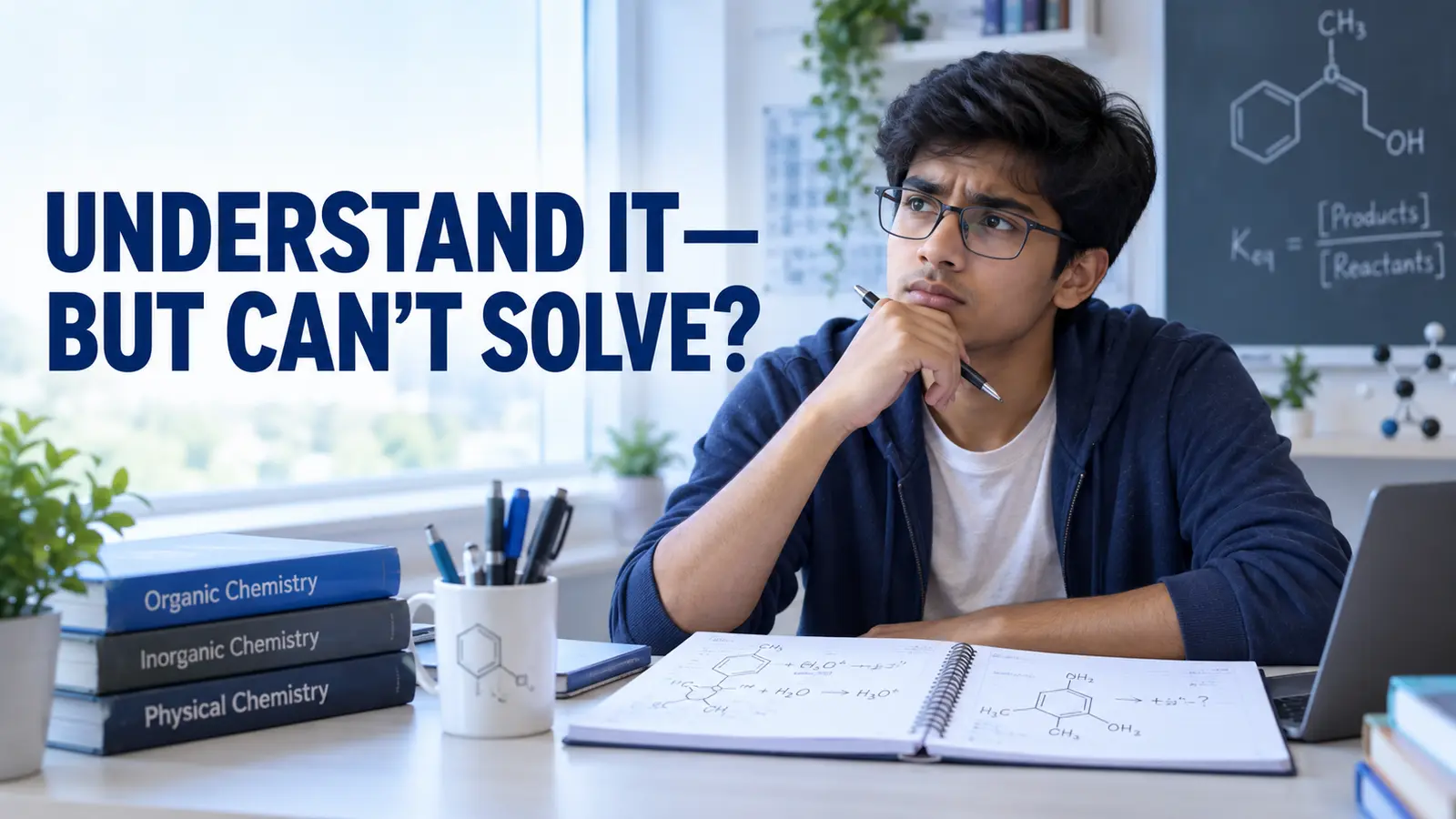
    If you understand Chemistry in class but cannot solve questions independently, the problem is usually not intelligence or effort. One link in your problem-solving chain is weak: interpreting the question, recalling the right concept, connecting ideas, choosing a method, executing accurately, checking the answer, or learning from errors. The solution is to diagnose the exact link that breaks and practise that link deliberately—not simply reread the chapter or solve more questions blindly.

    This difficulty is common among sincere students. A teacher’s explanation feels clear, the notes make sense, and solved examples look manageable. Yet a fresh question creates a blank mind. That happens because recognition during a lesson is different from retrieval and application without support. This seven-step diagnostic plan helps students convert “I understand it” into “I can use it.”

    The seven-stage Chemistry problem-solving chain

    Successful problem solving is a chain. A student must move through all seven stages:

    1. Interpret: understand what the question gives and asks.
    2. Recall: retrieve the relevant concept, law, reaction, trend or formula.
    3. Connect: link the given information with the recalled knowledge.
    4. Plan: choose a valid route before beginning calculations or mechanisms.
    5. Execute: carry out algebra, units, structures, equations and reasoning accurately.
    6. Verify: check units, sign, magnitude, conditions, chemical feasibility and whether the answer addresses the question.
    7. Learn: classify the error and convert it into a specific improvement.

    A weakness at any one stage can make the whole attempt fail. This is why the Topper Formula approach connects conceptual clarity with structured practice, assessment, analysis and improvement. It is also consistent with The Clarity Blueprint Method™: observe honestly, identify the real gap, choose a direction, act, reflect and improve consistently.

    A diagnostic table: find the real learning gap

    Observed difficultyLikely causeEvidence to checkCorrective action
    Cannot identify what is askedQuestion-language or interpretation gapCannot restate the task in one sentenceUnderline data, command word and target; rewrite the question plainly
    Remembers after seeing the solutionRecognition without retrievalBlank recall before opening notesUse closed-book recall and short spaced quizzes
    Knows facts but cannot startConnection or representation gapCannot link givens to a principle, equation or reaction familyMake “given → concept → target” maps
    Starts with the wrong formula or reactionMethod-selection gapNo written plan; trial-and-error begins immediatelyPause for a two-line plan and compare alternative routes
    Approach is correct but answer is wrongExecution weaknessUnit, sign, arithmetic, balancing or structure errorsWrite steps clearly and practise the specific micro-skill
    Accepts an impossible answerVerification habit missingNo unit, range, condition or feasibility checkUse a fixed 30-second final-check routine
    Repeats the same errorReview is passive or vagueNotebook records answers but not causes or retestsMaintain an error notebook with cause, correction and revisit dates

    How to diagnose each stage

    1. Interpret the question

    Before solving, ask: What information is given? What must I find, predict, compare or explain? Which conditions matter? Command words change the task. “Calculate,” “justify,” “predict,” “draw,” and “explain” require different responses. A student who misreads “rate constant” as “rate,” ignores temperature, or misses “major product” may know the chapter but answer a different question.

    2. Recall without looking

    Close the book and write the relevant law, definition, trend or reaction conditions from memory. If recall appears only after seeing a hint, knowledge is familiar but not yet retrievable. Strengthen it with spaced recall, flash prompts, formula reconstruction and blank reaction maps. Rereading can support understanding, but it cannot replace retrieval practice.

    3. Connect data to concepts

    Many unfamiliar questions are familiar concepts in a new form. Convert words into a representation: a mole table, energy diagram, mechanism, periodic trend, oxidation-state map or labelled equation. Then complete the sentence: “Because the question gives ___ and asks ___, I should use ___.” If that sentence is unclear, the connection stage needs work.

    4. Plan the route

    Do not calculate at the first sight of numbers. Write a short route. For example: convert mass to moles → identify limiting reagent → calculate product moles → convert to required unit. In Organic Chemistry: identify functional group → examine reagent and conditions → decide reaction type → check rearrangement or selectivity → draw product. Planning reduces random formula use.

    5. Execute accurately

    Execution is a separate skill. Keep equations visible, carry units, balance reactions, show charges, place arrows carefully and avoid skipping mental steps that frequently cause errors. When the concept and route are correct but the final answer is wrong, do not relearn the whole chapter; practise the precise weakness—algebra, mole ratios, structures, nomenclature or equation balancing.

    6. Verify chemically

    Ask whether the result makes chemical sense. Is the unit correct? Is a percentage between 0 and 100? Does concentration remain non-negative? Is the oxidation state possible? Does the proposed product match the reagent and conditions? Could steric, electronic or stability effects change the outcome? Verification catches errors before they become marks lost.

    7. Learn from the attempt

    “Careless mistake” is not a useful diagnosis. Name the cause precisely: missed qualifier, weak recall, wrong representation, unsuitable method, unit conversion, sign error, incomplete condition, or failure to verify. Then write one corrective rule and schedule a fresh attempt. Improvement comes from changing the process that produced the mistake.

    Examples from Physical, Organic and Inorganic Chemistry

    Physical Chemistry: equilibrium calculation

    A student may understand equilibrium and still substitute initial concentrations directly into an equilibrium-constant expression. The real gap is not the formula; it is representation. Build an initial–change–equilibrium table, apply stoichiometry, then substitute equilibrium values. Finally check whether the calculated change is physically possible. The diagnosis directs practice toward setup, not another reading of equilibrium theory.

    Organic Chemistry: predicting the major product

    A student may remember individual reactions but fail when substrate, reagent and condition appear together. Use a decision sequence: identify the functional group; classify reagent as nucleophile, electrophile, acid, base, oxidant or reductant; notice solvent, heat and stereochemical information; compare substitution, elimination, addition or rearrangement routes; then justify the major product. Reaction maps should show conditions and competing pathways, not products alone.

    Inorganic Chemistry: explaining a periodic trend

    Memorising that ionisation enthalpy generally increases across a period is not enough. For an exception, the student must connect electronic configuration, effective nuclear charge, subshell energy, penetration, shielding and pairing. A strong answer names the governing factor and applies it to the compared species. Practise “claim → reason → evidence → exception” explanations rather than isolated trend lists.

    A practical seven-day improvement plan

    1. Day 1—Baseline: attempt 12 mixed questions without notes. Mark the stage where each attempt breaks.
    2. Day 2—Interpretation: take 15 questions and write only givens, target, conditions and command word.
    3. Day 3—Recall: reconstruct key formulas, trends and reactions from a blank page, then correct in another colour.
    4. Day 4—Connections: create eight “given → concept → method” maps from Physical, Organic and Inorganic Chemistry.
    5. Day 5—Planning and execution: solve a graded set, writing a two-line plan before every solution.
    6. Day 6—Verification: revisit solved questions and apply unit, sign, magnitude, condition and feasibility checks.
    7. Day 7—Retest: reattempt the original 12 questions plus six similar questions. Compare stage-wise errors, not only marks.

    One week will not finish Chemistry, but it can reveal why progress has stalled and establish a better practice system. Continue the cycle chapter by chapter. Useful worksheets and study materials can be found in Books and Resources. For structured test practice and feedback, explore the Topper Formula learning platform for students.

    How to use an error notebook correctly

    An error notebook is not a collection of copied solutions. For each significant error, record: date and topic; a short question reference; the stage that failed; the exact cause; the corrected principle or method; one prevention rule; and two revisit dates. Reattempt the question without seeing the solution after 48 hours and again after one week. Mark it closed only after you can solve it and explain why the earlier approach failed.

    Keep the notebook selective. Record recurring misconceptions, high-value methods and errors that reveal a pattern. Do not spend more time decorating it than learning from it. For a deeper distinction between teaching support and wider learning support, read Student Mentoring vs Tuition: What Is the Difference?

    Responsible guidance for parents

    When a child says, “I understand but cannot solve,” avoid immediately labelling the child lazy, careless or weak. Ask to see two or three attempts and identify where the process stops. Praise honest diagnosis and disciplined correction, not only marks. Provide a quiet routine, realistic practice blocks and access to appropriate help. The Parent Guidance section offers additional support for constructive conversations.

    Do not compare the child constantly with classmates or demand guaranteed improvement in a fixed number of days. Persistent anxiety, sleep disturbance, panic, very low mood, attention difficulties or major changes in functioning deserve sensitive discussion with a qualified healthcare or mental-health professional. Academic advice should not be used as a substitute for clinical assessment.

    When tuition, mentoring, counselling or professional help may be appropriate

    • Subject tuition: when foundational Chemistry concepts, calculations, mechanisms or examination methods remain weak despite regular study.
    • Academic mentoring: when the student understands subjects but struggles with planning, consistency, study habits, self-monitoring, confidence or examination strategy. Explore Student Mentoring.
    • Counselling: when confusion about choices, motivation, relationships or emotional pressures needs a trained counsellor’s support.
    • Another qualified professional: when suspected learning, attention, vision, hearing, sleep or mental-health difficulties materially affect daily functioning or learning.

    The right response depends on evidence. A student may need one form of support, a combination, or simply a better practice method.

    Frequently asked questions

    Why do I understand Chemistry in class but cannot solve questions alone?

    Classroom understanding often provides explanations, prompts and worked steps, while independent questions require retrieval, interpretation and method selection without support. Test the seven stages separately. Your difficulty may be weak recall, failure to connect data with concepts, poor planning, execution errors or a missing verification habit.

    Should I reread the chapter when I cannot solve Chemistry questions?

    Reread only when diagnosis shows a genuine concept gap. If you can explain the idea but cannot apply it, use closed-book recall, worked-example fading and graded problem practice instead. Always reattempt the question after studying the solution; otherwise familiarity may be mistaken for independent ability.

    How many Chemistry questions should I solve each day?

    There is no universal number. A focused set of 10–20 well-chosen questions, analysed properly, can be more useful than 50 rushed attempts. Balance basic retrieval, standard applications and a few unfamiliar problems. Track accuracy, time and error type so volume increases only when the process remains sound.

    How can I improve numerical problem solving in Physical Chemistry?

    Separate setup from calculation. Write the givens with units, name the governing law, draw a mole or equilibrium table when needed, and plan conversions before substituting. Practise algebra and unit conversion as micro-skills. After solving, check dimensions, sign and whether the magnitude is chemically reasonable.

    How do I remember Organic Chemistry reactions for application questions?

    Organise reactions by functional group, reagent type, mechanism and conditions instead of memorising isolated equations. Build reaction maps that include competing pathways, selectivity and common exceptions. Practise predicting products before viewing answers, then explain the electron movement and why an alternative pathway is less favoured.

    When should a student seek a Chemistry tutor or mentor?

    Consider a Chemistry tutor when repeated evidence shows unresolved subject gaps or weak problem-solving methods. Consider academic mentoring when planning, consistency, confidence or self-monitoring is the larger difficulty. Choose support after reviewing actual attempts, and avoid anyone promising guaranteed marks or instant transformation.

    About the author

    Lalit Kumar Mishra is a Chemistry Educator, Student Success Mentor and Author with more than 20 years of teaching experience. He is the Founder of Topper Formula, Creator of The Clarity Blueprint Method™, and has guided more than 5,000 students. Learn more about Lalit Kumar Mishra.

    Need help identifying the real Chemistry learning gap?

    Share the student’s class, current topic and main difficulty so the most suitable next step—self-correction, subject tuition or academic mentoring—can be reviewed responsibly.

    Send an enquiry

    Connect this skill to equilibrium and kinetics: See how researchers are modelling changing-temperature operation in ammonia synthesis in Can Changing Temperature Improve Ammonia Synthesis?

  • Is Your Child Not Studying Enough — or Using the Wrong Study System?

    A disappointing score does not automatically mean a child is lazy or not studying enough. The more useful question is whether the difficulty comes from effort, concept understanding, study method, revision, or test performance.

    Parents usually see the visible part of preparation: hours at the desk, books open, notes being made, and tuition attended. Marks, however, depend on what happens inside those hours. A student can work sincerely and still use a system that produces familiarity rather than recall, activity rather than progress, or knowledge that cannot be reproduced under exam conditions.

    First, Separate Effort from Method

    Effort answers, “Is the student showing up and attempting the work?” Method answers, “Are those attempts designed to produce understanding, memory, application, and marks?” Both matter, but they require different conversations.

    If effort is genuinely low, the family may need to address routine, distractions, priorities, sleep, or avoidance. If effort is present but results remain weak, adding more hours may only create exhaustion. The study process needs to be examined.

    Five Different Problems That Can Look Like “Not Studying”

    1. A Real Effort or Follow-Through Problem

    Signs include repeatedly postponing agreed tasks, avoiding all difficult work, studying only when supervised, and having no record of completed practice. The solution is not a harsher lecture. It is a realistic minimum routine, fewer distractions, visible task completion, and calm accountability.

    Parent question: “What small piece of work can you complete independently every day this week?”

    2. A Concept Gap

    The student may read and remember definitions but become stuck when a question changes its wording or combines two ideas. In mathematics and science, missing one prerequisite can make later chapters feel much harder.

    Check it: Ask the student to explain the idea without notes, show why a step works, and solve one familiar plus one unfamiliar question. If the explanation breaks at the same point, repair that concept before demanding more practice.

    3. An Ineffective Study Method

    Passive reading, copying notes, highlighting, and replaying explanations can feel productive because they are comfortable. Exams require active retrieval and independent application.

    Check it: After a study session, can the student close the book and write the main points, solve questions without hints, or explain the chapter in simple language? If not, shift time from input to retrieval, problem solving, and written answers.

    4. A Revision Gap

    Some students understand a chapter when it is taught but do not return to it until the examination. Forgetting is then interpreted as poor ability. Often the real missing element is a revision schedule.

    Check it: Is every completed topic assigned a short next-day review, a weekly retrieval check, and later mixed practice? Revision should be planned before the feeling of forgetting appears.

    5. A Test-Performance Problem

    A student can know the material and still lose marks through rushed reading, careless signs, weak time allocation, poor question selection, incomplete steps, or freezing under pressure.

    Check it: Review the actual answer sheet. Label lost marks as concept, recall, careless, time, interpretation, presentation, or incomplete-revision errors. The pattern is more useful than the score.

    A Seven-Day Home Diagnostic

    Choose one subject and observe the process for seven days. Avoid changing everything at once.

    1. Write one measurable outcome for each session.
    2. Record focused minutes, not merely time at the desk.
    3. End each session with a closed-book recall or five independent questions.
    4. Schedule one short revision of earlier material.
    5. Attempt a timed mini-test.
    6. Classify errors without criticism.
    7. Decide which single gap most affected output.

    How to Talk So the Student Can Think Clearly

    Replace “You are not serious” with evidence-based questions:

    • “Which part did you understand, and where did you become unsure?”
    • “What did you do after reading the chapter?”
    • “Which mistakes repeated from the previous test?”
    • “What one change will you test for the next seven days?”

    This keeps responsibility with the student while reducing shame. The aim is not to excuse weak preparation; it is to make the cause specific enough to correct.

    When Guidance Can Help

    If the family keeps repeating the same arguments or cannot identify the dominant gap, structured student clarity and academic performance mentoring can help. Parents can also explore the Parent Guidance resources and the Clarity Blueprint framework for reflection, direction, and consistent action.

    For a structured starting point, take the free Student Performance Diagnostic from The Clarity Blueprint. It helps students and parents identify the most likely gap before choosing the next action.

    The Right Conclusion

    Do not decide too quickly that a child is not trying. Look for evidence. If effort is absent, build a workable routine and accountability. If effort is present, identify whether concepts, active study, revision, test execution, or confidence is the weakest link. A precise problem creates a practical next step—and that is far more helpful than simply demanding more hours.

  • Mendeleev’s Periodic Table: Merits and Limitations

    Quick answer: Mendeleev arranged elements mainly in increasing atomic mass while placing elements with similar chemical properties in the same groups. His table successfully predicted undiscovered elements and corrected some atomic masses. Its limitations included uncertain hydrogen placement, inability to explain isotopes and anomalous element pairs that did not follow atomic-mass order.

    What you will learn

    • Basis of Mendeleev’s periodic law
    • Groups and periods in Mendeleev’s table
    • Prediction of undiscovered elements
    • Major merits and historical importance
    • Limitations resolved by the modern periodic table

    Important questions answered

    What is Mendeleev’s periodic law?

    The properties of elements are periodic functions of their atomic masses.

    What was Mendeleev’s greatest achievement?

    He left gaps and predicted the existence and properties of undiscovered elements with impressive accuracy.

    Why were isotopes a problem for Mendeleev’s table?

    Isotopes have different atomic masses but nearly identical chemical properties, so mass-based placement could not explain them.

    How did the modern periodic table solve anomalous pairs?

    It arranged elements by atomic number rather than atomic mass.

    Who should use this lesson?

    This lesson is useful for school students, competitive-exam aspirants, parents supporting a learner and teachers looking for a clear explanation. Watch the complete video, make short notes and then practise the ideas without looking at the solution.

    Learn with Lalit Kumar Mishra

    Lalit Kumar Mishra is a chemistry educator, student success mentor, author and Founder of Topper Formula, with more than 20 years of teaching experience. Explore more learning and mentoring resources on the Resources page.

  • Haloalkanes and Haloarenes: Introduction and IUPAC Nomenclature

    Quick answer: Haloalkanes are formed when a halogen replaces hydrogen on an sp³ carbon of an aliphatic hydrocarbon. In haloarenes, the halogen is directly attached to an aromatic sp² carbon. Correct IUPAC naming requires selecting and numbering the parent chain or ring, identifying halogen substituents and arranging prefixes alphabetically.

    What you will learn

    • Difference between haloalkanes and haloarenes
    • Classification by number and position of halogens
    • Allylic, benzylic, vinylic and aryl halides
    • Common names and IUPAC nomenclature
    • NCERT Class 12 naming practice

    Video chapters

    • 0:00 Lesson Introduction
    • 0:32 What are Haloalkanes and Haloarenes?
    • 3:21 Classification of Haloalkanes
    • 7:39 Classification by sp³ and sp² Carbon
    • 9:29 Aryl Halides and Haloarenes
    • 12:34 IUPAC Nomenclature Rules
    • 13:01 NCERT Exercise 10.1 Naming Examples
    • 30:14 Advanced Nomenclature Practice
    • 36:57 Lesson Recap

    Important questions answered

    What is a haloalkane?

    It is an aliphatic compound in which one or more hydrogen atoms are replaced by halogens attached to sp³-hybridised carbon.

    What is a haloarene?

    It is an aromatic compound in which a halogen is directly bonded to an sp² carbon of an aromatic ring.

    How are haloalkanes named in IUPAC nomenclature?

    Choose the longest carbon chain, number it for the lowest substituent locants and use fluoro, chloro, bromo or iodo as prefixes.

    What is the difference between geminal and vicinal dihalides?

    Geminal dihalides have both halogens on the same carbon; vicinal dihalides have them on adjacent carbons.

    Who should use this lesson?

    This lesson is useful for school students, competitive-exam aspirants, parents supporting a learner and teachers looking for a clear explanation. Watch the complete video, make short notes and then practise the ideas without looking at the solution.

    Learn with Lalit Kumar Mishra

    Lalit Kumar Mishra is a chemistry educator, student success mentor, author and Founder of Topper Formula, with more than 20 years of teaching experience. Explore more learning and mentoring resources on the Resources page.

  • Alkanes: Isomerism, Preparation and Properties | Class 11

    Quick answer: Alkanes are saturated hydrocarbons containing only carbon–carbon and carbon–hydrogen single bonds. They show chain isomerism from butane onward. Common preparation methods include hydrogenation, decarboxylation, the Wurtz reaction and reduction of alkyl halides. Their main reactions are combustion, free-radical substitution and controlled oxidation.

    What you will learn

    • Structure and nomenclature of alkanes
    • Chain isomerism and structural formulae
    • Important laboratory preparation methods
    • Physical properties and trends
    • Combustion and free-radical substitution reactions

    Important questions answered

    What are alkanes?

    Alkanes are saturated open-chain hydrocarbons with the general formula CnH2n+2.

    When do alkanes show chain isomerism?

    Chain isomerism begins with butane because four carbon atoms can be connected in more than one carbon skeleton.

    What is the Wurtz reaction?

    Two alkyl halide molecules react with sodium metal in dry ether to form a higher alkane.

    Why are alkanes relatively unreactive?

    Their C–C and C–H sigma bonds are strong and almost non-polar.

    Who should use this lesson?

    This lesson is useful for school students, competitive-exam aspirants, parents supporting a learner and teachers looking for a clear explanation. Watch the complete video, make short notes and then practise the ideas without looking at the solution.

    Learn with Lalit Kumar Mishra

    Lalit Kumar Mishra is a chemistry educator, student success mentor, author and Founder of Topper Formula, with more than 20 years of teaching experience. Explore more learning and mentoring resources on the Resources page.

  • Modern Periodic Law, Periodic Table and Electronic Configuration

    Quick answer: The modern periodic law states that the physical and chemical properties of elements are periodic functions of their atomic numbers. Increasing atomic number produces recurring valence-shell configurations, which explains the structure of groups and periods. Electronic configuration therefore determines an element’s block, position, typical valency and many periodic properties.

    What you will learn

    • Statement and meaning of modern periodic law
    • Long form of the modern periodic table
    • Groups, periods and s, p, d and f blocks
    • Finding position from electronic configuration
    • Connections with periodic trends

    Important questions answered

    What is the modern periodic law?

    The properties of elements are periodic functions of their atomic numbers.

    Why is atomic number used instead of atomic mass?

    Atomic number represents nuclear charge and determines electronic configuration, which directly controls chemical behaviour.

    How does electronic configuration locate an element?

    The highest principal shell gives the period, while the valence configuration helps identify the group and block.

    Who should use this lesson?

    This lesson is useful for school students, competitive-exam aspirants, parents supporting a learner and teachers looking for a clear explanation. Watch the complete video, make short notes and then practise the ideas without looking at the solution.

    Learn with Lalit Kumar Mishra

    Lalit Kumar Mishra is a chemistry educator, student success mentor, author and Founder of Topper Formula, with more than 20 years of teaching experience. Explore more learning and mentoring resources on the Resources page.

  • Galvanic Cell, Nernst Equation and Gibbs Energy: Class 12 Guide

    Quick answer: A galvanic cell converts the energy of a spontaneous redox reaction into electrical energy. Oxidation occurs at the anode, reduction occurs at the cathode and electrons flow through the external circuit. The Nernst equation calculates cell potential under non-standard conditions, while ΔG = −nFE connects cell potential with Gibbs energy and spontaneity.

    What you will learn

    • Construction and working of a galvanic cell
    • Daniell cell, anode, cathode and salt bridge
    • Standard electrode and cell potentials
    • Relationship between Ecell and Gibbs free energy
    • Nernst equation and numerical applications

    Video chapters

    • 0:00 Introduction to Electrochemistry
    • 2:18 What is an Electrochemical Cell?
    • 4:51 Electrochemical vs Electrolytic Cells
    • 9:55 Daniell Cell Construction and Working
    • 12:40 Standard Electrode Potential
    • 16:36 Oxidation and Reduction
    • 20:42 Salt Bridge
    • 31:29 Cell Potential and Gibbs Free Energy
    • 42:15 Nernst Equation
    • 50:26 Nernst Equation Numericals
    • 59:52 Lesson Recap

    Important questions answered

    What is a galvanic cell?

    It is an electrochemical cell that produces electrical energy from a spontaneous oxidation–reduction reaction.

    What is the function of a salt bridge?

    It completes the internal circuit, maintains electrical neutrality and limits direct mixing of the two electrolytes.

    How are Gibbs energy and cell potential related?

    They are related by ΔG = −nFE. A positive cell potential gives a negative ΔG for a spontaneous cell reaction.

    What does the Nernst equation calculate?

    It calculates electrode or cell potential when concentration, pressure or other reaction conditions are not standard.

    Who should use this lesson?

    This lesson is useful for school students, competitive-exam aspirants, parents supporting a learner and teachers looking for a clear explanation. Watch the complete video, make short notes and then practise the ideas without looking at the solution.

    Learn with Lalit Kumar Mishra

    Lalit Kumar Mishra is a chemistry educator, student success mentor, author and Founder of Topper Formula, with more than 20 years of teaching experience. Explore more learning and mentoring resources on the Resources page.

  • Stoichiometry and Limiting Reagent Numericals: Class 11 Guide

    Quick answer: Stoichiometry uses a balanced chemical equation to calculate quantitative relationships among reactants and products. Convert the given data into moles, compare it with equation coefficients and identify the limiting reagent when more than one reactant is supplied. The limiting reagent is consumed first and determines the maximum product formed.

    What you will learn

    • Meaning and method of stoichiometric calculation
    • Mass-to-mass and volume-to-mass conversions
    • Using balanced-equation mole ratios
    • Identifying the limiting reagent
    • Exam-oriented Class 11, JEE and NEET numericals

    Video chapters

    • 0:00 Introduction
    • 0:54 What is Stoichiometry?
    • 2:03 Mass-to-Mass Stoichiometry Example
    • 5:05 Volume-to-Mass Stoichiometry Example
    • 8:05 CaCO3–HCl Neutralisation Example
    • 12:54 Limiting Reagent Concept
    • 15:13 How to Identify the Limiting Reagent
    • 21:04 Summary and Exam Approach

    Important questions answered

    What is stoichiometry?

    Stoichiometry is the quantitative calculation of reactants and products using the mole ratios in a balanced chemical equation.

    How is the limiting reagent identified?

    Convert each reactant into moles and divide by its stoichiometric coefficient. The reactant with the smaller usable ratio is limiting.

    Why must the equation be balanced first?

    Only a balanced equation gives the correct mole ratio required for quantitative calculations.

    Who should use this lesson?

    This lesson is useful for school students, competitive-exam aspirants, parents supporting a learner and teachers looking for a clear explanation. Watch the complete video, make short notes and then practise the ideas without looking at the solution.

    Learn with Lalit Kumar Mishra

    Lalit Kumar Mishra is a chemistry educator, student success mentor, author and Founder of Topper Formula, with more than 20 years of teaching experience. Explore more learning and mentoring resources on the Resources page.

  • Mole Concept and Its Applications: Class 11 Chemistry Guide

    Quick answer: The mole concept connects microscopic particles with measurable laboratory quantities. One mole contains 6.022 × 10²³ entities. Using molar mass, Avogadro’s constant and gas-volume relationships, students can convert among mass, moles, number of particles and volume and then apply these conversions to chemical calculations.

    What you will learn

    • Meaning of one mole and Avogadro’s constant
    • Molar mass and mass–mole conversion
    • Particles, atoms, molecules and formula units
    • Gas-volume relationships
    • Applications in stoichiometric calculations

    Important questions answered

    What is one mole?

    One mole is the amount of substance containing 6.022 × 10²³ specified entities such as atoms, molecules, ions or formula units.

    How do you convert mass into moles?

    Divide the given mass by the molar mass of the substance: moles = given mass ÷ molar mass.

    Why is the mole concept important?

    It is the calculation language of chemistry and is required for stoichiometry, solutions, gases, equilibrium and electrochemistry.

    Who should use this lesson?

    This lesson is useful for school students, competitive-exam aspirants, parents supporting a learner and teachers looking for a clear explanation. Watch the complete video, make short notes and then practise the ideas without looking at the solution.

    Learn with Lalit Kumar Mishra

    Lalit Kumar Mishra is a chemistry educator, student success mentor, author and Founder of Topper Formula, with more than 20 years of teaching experience. Explore more learning and mentoring resources on the Resources page.

  • Periodic Classification of Elements: Class 11 Chemistry Guide

    Quick answer: Periodic classification arranges elements so that recurring chemical and physical properties become easy to understand and predict. The modern periodic table is based on atomic number and electronic configuration. Elements in the same group show related valence-shell configurations, while properties change systematically across periods and down groups.

    What you will learn

    • Need for periodic classification
    • Groups, periods and blocks of the modern periodic table
    • Relationship with electronic configuration
    • Periodic trends and prediction of properties
    • CBSE, NCERT, JEE and NEET relevance

    Important questions answered

    What is periodic classification?

    It is the systematic arrangement of elements according to atomic number and recurring properties so similarities, differences and trends can be studied together.

    Why do elements in one group have similar properties?

    They generally have similar valence-shell electronic configurations, which control bonding and chemical behaviour.

    Why is this chapter important for JEE and NEET?

    It provides the foundation for chemical bonding, inorganic chemistry and trend-based reasoning questions.

    Who should use this lesson?

    This lesson is useful for school students, competitive-exam aspirants, parents supporting a learner and teachers looking for a clear explanation. Watch the complete video, make short notes and then practise the ideas without looking at the solution.

    Learn with Lalit Kumar Mishra

    Lalit Kumar Mishra is a chemistry educator, student success mentor, author and Founder of Topper Formula, with more than 20 years of teaching experience. Explore more learning and mentoring resources on the Resources page.